The Apparo Readiness Report (2026)
Understanding the readiness gap facing young people today.
This report brings together primary research with learners, educators, employers, and recruiters alongside national policy, labour market and education research to understand why the transition into work has become more challenging for today's young people.
July 2026
Every year, thousands of capable young people leave education and begin the transition into work, apprenticeships, and adult life.
Many succeed.
Many don't.
The question is why?
Over the past year, Apparo has brought together evidence from learners, educators, employers, recruiters, and national research to understand the practical challenges young people experience during that transition.
Although these perspectives come from very different people and organisations, they repeatedly point towards the same conclusion.
Young people are not leaving education lacking intelligence or potential. They are leaving without enough opportunity to learn the practical knowledge, behaviours, and confidence that modern adult life increasingly expects from day one.
This isn't a report about what young people lack.
It's a report about what too many have never had the opportunity to learn.
What young people experience
For many young people, the transition from education into work isn't exciting, it's uncertain.
Not because they doubt their potential, but because they are entering environments they've never been shown how to navigate.
Across our own research conversations, the same concerns surfaced repeatedly. Students aren’t worried about technical skills. They’re worried about everything surrounding them.
How do I know what to wear?
What if I say the wrong thing?
How do I ask for help?
What if everyone else already knows what they're doing?
What if I make a mistake?
What if people judge me?
These weren't isolated comments.
They emerged consistently across discussions about first jobs, work experience, interviews, and the move into adult life.
"When I started working, I was scared because I wanted to do the right thing... but no one else there was new. They'd all been there quite a long time, and I'd never really done anything like that before."
Year 12 student reflecting on their first job
That concern resurfaced repeatedly throughout the discussion. Students weren't describing a lack of ability. They were describing the anxiety of entering an unfamiliar environment where everyone else already seemed to know the rules.
One student summarised it simply:
"More just not knowing what to do."
Students described worrying about joining established teams where everyone else already knew how things worked.
They worried about making mistakes and getting things wrong.
They worried about being judged and being left to work things out for themselves.
One student described:
"A lack of direction."
Another spoke about colleagues already having
"their own little circle."
This anxiety isn’t about intelligence. It’s about entering a world with invisible expectations.
The same pattern continued beyond employment. When discussions turned to adult life, students described uncertainty around tax, renting, contracts, pensions, credit scores, and financial decisions.
One student's description captured the challenge particularly well:
"Things a parent probably handles."
Another simply said:
"How to not get scammed."
These aren’t niche concerns. They’re practical aspects of adult life that students recognised they would soon face, but don't yet know how to navigate.
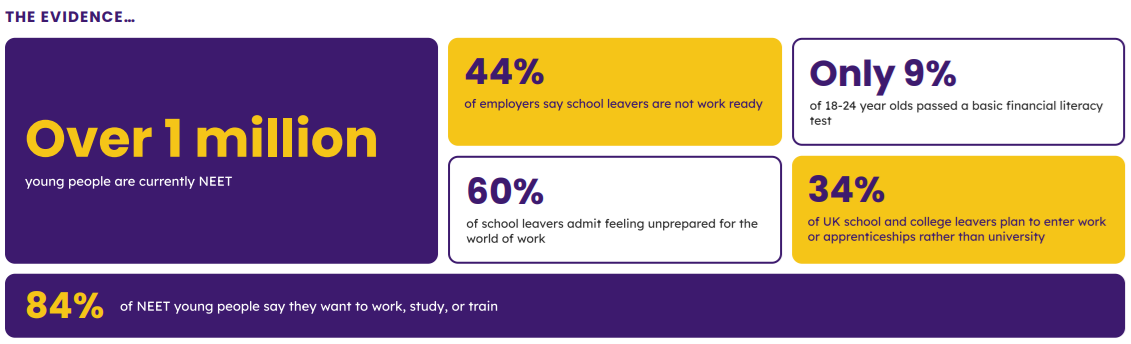
Only 9%
of 18–24-year-olds passed a basic financial literacy test.
Shepherds Friendly, 2025
That figure matters here because the concerns students raised about tax, renting, contracts, and credit scores in our research weren't simply vague anxieties. National evidence suggests that most young adults genuinely haven't been equipped with this knowledge, regardless of how academically capable they are.
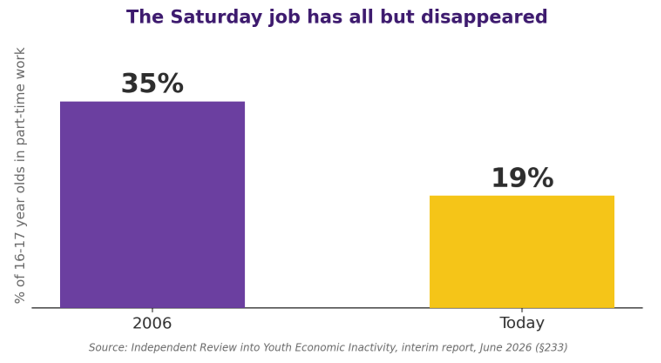
These concerns are emerging at a time when many young people have had fewer opportunities than previous generations to experience workplaces before entering them - traditional stepping stones such as Saturday jobs and meaningful work experience have declined significantly.
Taken individually, these concerns might appear small. Together, they describe something much larger.
Not a lack of ambition.
Not a lack of ability.
But a generation preparing to enter adult life while feeling uncertain about many of the practical situations they know are waiting for them.
Only 9%
of 18–24-year-olds passed a basic financial literacy test.
Shepherds Friendly - 2025
That figure matters here because the concerns students raised about tax, renting, contracts and credit scores in our research weren't simply vague anxieties.
National evidence suggests that most young adults genuinely haven't been equipped with this knowledge, regardless of how academically capable they are.
What educators are already seeing.
Across different schools, different cohorts, and different educational settings, experienced educators described remarkably similar observations.
The concern isn’t that young people lack intelligence or ambition. It’s that many are reaching the end of formal education without feeling genuinely prepared for what comes next.
Perhaps most strikingly, these observations emerged before Apparo was ever discussed.
They weren't responses to a proposed solution.
They were descriptions of an existing problem.
‘Students nowadays just aren't prepared to have those face-to-face conversations. They're absolutely petrified of having to engage with adults. Often the ones who don't want to go to university are the ones who struggle most.’
Head of Futures: Independent School - July 2026
Notice what isn't being discussed…
Academic ability.
Subject knowledge.
Examination results.
Instead, the concern centres on confidence, communication, and navigating professional environments.
In the same conversation, this distinction became even clearer…
‘Employers will train you to do the job. What they cannot train is cultural fit, engagement, and basic professional behaviour.’
These observations aren’t confined to just one school.
Across three very different educational settings - including a large urban academy, an independent school, and a comprehensive school - the same conversations emerge repeatedly.
…Different students.
…Different demographics.
…Different contexts.
The same underlying concern:
Young people are achieving academically, but many still felt unprepared for the practical realities of work and adult life.
And I think this is the key insight:
"Structurally, we're really restricted by the timetable... half the time we're limited by the timetable rather than by what we'd actually like to offer."
This is not happening because schools don't recognise the problem.
Even when they do, they often struggle to create the curriculum space to address it consistently.
That distinction reframes the issue from one of awareness to one of capacity.
At the same time, schools face increasing expectations around employability, personal development, and destination outcomes, while curriculum time has become increasingly constrained.
‘Students nowadays just aren't prepared to have those face-to-face conversations. They're absolutely petrified of having to engage with adults. Often the ones who don't want to go to university are the ones who struggle most.’
Head of Futures: Independent School - July 2026
What employers keep describing.
For employers, the challenge rarely begins with technical ability.
Most organisations expect to teach people how to perform the job itself. The greater challenge is helping new starters navigate the professional environment around it.
Communication.
Professional behaviour.
Confidence.
Knowing what is expected before someone has to explain it.
Across employer conversations, these practical workplace behaviours were repeatedly described as the factors that most often determined whether a new starter settled successfully.
‘Employers will train you to do the job. What they cannot train is cultural fit, engagement, and basic professional behaviour.’
This distinction appears consistently throughout the wider evidence base. Employers are not asking schools to produce fully trained employees.
Only 3%
of employers recruiting school leavers identified poor literacy or numeracy as the main issue.
The overwhelming majority pointed instead to workplace familiarity, confidence, and work readiness.
Independent Review into Youth Economic Inactivity - June 2026
Employers expect to provide role-specific training themselves. What they repeatedly value are the practical behaviours that allow someone to succeed once they arrive:
communicating professionally
asking for help appropriately
working with colleagues
understanding workplace expectations
behaving with confidence and professionalism
These are rarely assessed through examinations, yet they are often judged within the first few days of employment.
Employers themselves are operating in a labour market that has become more cautious, more structured, and increasingly reliant on formal recruitment processes.
Taken together, these conversations suggest that the challenge is not simply preparing young people to secure employment. It is preparing them to succeed once they get there.
That distinction sits at the heart of the readiness gap.
44%
of UK employers say school leavers are not work-ready.
Independent Review into Youth Economic Inactivity
Only 3%
of employers recruiting school leavers identified poor literacy or numeracy as the main issue.
The overwhelming majority pointed instead to workplace familiarity, confidence and work readiness.
Independent Review into Youth Economic Inactivity
What recruiters experience every day
Recruitment sits at the point where education meets employment.
It is where preparation, confidence, and professional behaviours stop being theoretical and begin to influence real decisions.
For that reason, recruitment professionals often see patterns long before they appear in national statistics.
"It's the stuff nobody writes down that finishes him. The job; he could always do. It's the unwritten rules that he doesn't know."
Greg Hines, Head of Partnerships, Recruitment Agency - Based on 27 years of recruitment and operations experience across industrial, engineering and logistics sectors, including employers such as DHL, Amazon and Tesco.
Greg's observation shifts the discussion in an important way.
The issue isn't whether young people are capable of doing the job, it's whether they understand the professional environment surrounding it. That difference is significant.
Technical skills can be taught.
The unwritten rules are often assumed.
Across the conversation, the same examples surfaced repeatedly.
Young people who:
don’t know how to report sickness appropriately
communicate with managers using the channels they used with friends
misunderstand basic expectations around attendance and responsibility
feel overwhelmed by workplace relationships that operate very differently from school
arrive technically capable but unfamiliar with the professional behaviours expected from day one
None of these problems reflect a lack of intelligence. They reflect a lack of exposure.
For recruitment agencies, these moments have measurable consequences. Placements that fail during the first weeks create additional cost, damage client relationships, and reduce profitability.
Preparation is therefore not simply an educational issue. It is a commercial one.
As Greg explained:
"That's the fear we live with. We go through all the work to get the vacancy… At that point we're thinking, 'Please don't let me down.'"
Across almost three decades of recruitment, the pattern Greg describes is remarkably consistent. Early placement failures are rarely caused by a lack of technical ability. They are far more often the result of young people encountering workplace expectations they have never previously been taught how to navigate.
Recruitment professionals increasingly describe entry-level hiring as more competitive, more automated, and more dependent on professional behaviours than at any point in previous decades.
"I was basically just doing the assessment centres… I wasn't making it past the HireVue stages. It's essentially a recorded stage where you have to answer questions about yourself."
Independent Review into Youth Economic Inactivity
What national evidence now confirms.
The conversations described so far took place independently.
Different young people.
Different schools.
Different employers.
Different recruiters.
The question became:
Was this simply a collection of individual experiences, or evidence of something much larger?
In 2026, the Independent Review into Youth Economic Inactivity reached many of the same conclusions from a national evidence base.
Rather than identifying a lack of intelligence or qualifications, the review described a growing disconnect between education and the realities of modern working life.
Its conclusion was striking - the transition itself has changed:
"The issue is less that young people lack basic skills, but that too many have had too little exposure to how workplaces operate before being expected to succeed in one."
The UK's experience isn't inevitable. Compared with many OECD countries, significantly fewer young people combine education with meaningful workplace experience before entering full-time employment. Countries with much higher participation rates typically report lower levels of youth economic inactivity.
The review describes the UK's transition into work as structurally weaker than it was for previous generations; traditional opportunities to learn workplace behaviours before entering full-time employment have steadily declined.
The report specifically identifies the collapse of work experience and the long-term decline of part-time employment among teenagers - including the traditional Saturday job - as key contributors to this changing landscape.
In addition, recruitment has become more demanding:
"I was basically just doing the assessment centres… I wasn't making it past the HireVue stages. It's essentially a recorded stage where you have to answer questions about yourself."
"I think they should get rid of the AI system that reads CVs..."
Independent Review into Youth Economic Inactivity - June 2026
Young people now enter a recruitment process that is more structured, more digital, and more competitive than previous generations experienced; automated screening, recorded interviews, and AI-assisted recruitment increasingly assess candidates before they ever speak to another person.
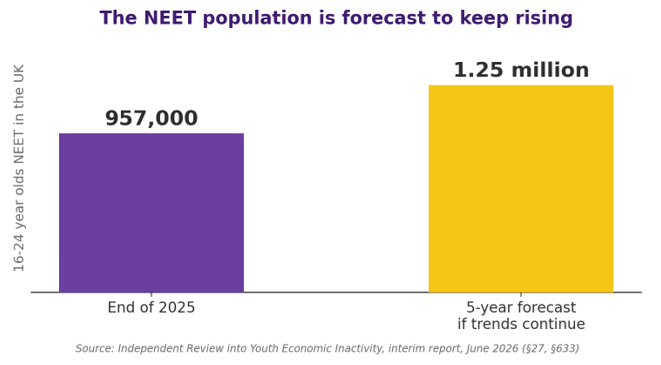
The review concludes that Britain's difficulties are no longer cyclical. They are structural. Nearly one million young people are now NEET, with forecasts suggesting this could rise to 1.25 million within five years if current trends continue.
Young people still want to work.
Perhaps the most important finding is also the simplest; the overwhelming majority of young people still want employment, education, or training.
The issue is not aspiration. It is the systems and transitions surrounding them.
Taken independently, each of these findings is significant. Taken together with the learner conversations, educator observations, employer perspectives, and recruitment experience presented earlier in this report, they point towards a remarkably consistent conclusion.
The readiness gap is real.
It is recognised from multiple perspectives.
And it appears to be becoming more significant rather than less.
The Independent Review estimates that the current economic cost of young people who are not in education, employment, or training is approximately £125 billion every year - a figure greater than the UK's annual education budget.
The case for helping young people make a successful transition into work is therefore not only educational…
It’s social.
It’s economic.
Increasingly, it’s national….
It’s becoming an economic imperative.
“The issue is less that young people lack basic skills, but that too many have had too little exposure to how workplaces operate before being expected to succeed in one.”
Independent Review into Youth Economic Inactivity
The UK's experience isn't inevitable.
Compared with many OECD countries, significantly fewer young people combine education with meaningful workplace experience before entering full-time employment.
Countries with much higher participation rates typically report lower levels of youth economic inactivity.
Why all of these perspectives point in the same direction.
Taken individually, each of the perspectives presented so far is valuable.
Young people describe uncertainty.
Educators describe growing gaps in practical readiness.
Employers describe the workplace behaviours they increasingly expect.
Recruiters describe the same transition failing for remarkably similar reasons.
National evidence points towards a structural weakening of the journey from education into employment.
Each perspective uses different language. Each sees the issue from a different position.
Yet they all describe the same underlying pattern.
Young people worry about:
not knowing what to do
making mistakes
fitting in
communicating professionally
navigating situations they have never experienced before
Educators describe limited curriculum time to address those challenges.
Employers expect those behaviours from day one.
Recruiters repeatedly see placements fail because those behaviours were never explicitly taught.
Government describes a generation with less exposure to workplaces, fewer opportunities to learn through experience, and a transition that has become structurally weaker than it was for previous generations.
These findings suggest that the issue is not one of motivation or intelligence. Nor is it a lack of technical ability. Instead, they point towards a preparation gap.
A generation expected to navigate increasingly complex workplaces and adult responsibilities, despite having fewer opportunities than previous generations to learn the practical knowledge, behaviours, and confidence those environments now assume.
→ Different perspectives.
→ Different evidence.
→ The same conclusion.
This conclusion did not emerge from a single conversation, nor from a single research report.
It emerged because independent evidence, gathered from learners, educators, employers, recruiters, and national policy repeatedly pointed in the same direction.
That consistency became impossible to ignore.
Educators describe limited curriculum time to address those challenges.
Employers expect those behaviours from day one.
Recruiters repeatedly see placements fail because those behaviours were never explicitly taught.
Government describes a generation with less exposure to workplaces, fewer opportunities to learn through experience, and a transition that has become structurally weaker than it was for previous generations.
Different perspectives.
Different evidence.
The same conclusion.
The platform that emerged.
By this point, the question is no longer whether a readiness gap exists; the evidence has answered that.
The question becomes something different.
If learners, educators, employers, recruiters, and national research are all describing the same challenge...
...what would a practical response actually look like?
The evidence doesn’t point towards another careers platform.
It doesn’t point towards another library of downloadable resources.
It doesn’t suggest more presentations, more worksheets, or more information.
Instead, it consistently points towards something practical.
✓ Something learners can use independently.
✓ Something that allows them to prepare before the moment matters.
✓ Something grounded in real situations rather than abstract advice.
That is the thinking that ultimately became Apparo.
Not a single feature.
Not a single conversation.
But the gradual convergence of multiple independent lines of evidence into one coherent response.
✓ Something learners can use independently.
✓ Something that allows them to prepare before the moment matters.
✓ Something grounded in real situations rather than abstract advice.
The evidence behind every major design decision.
Independent learning
Evidence:
Schools consistently described timetable constraints and limited capacity for additional teacher-led delivery.
Design response
Self-directed 20–30 minute modules requiring no teacher or facilitator.
Safe opportunities to practise
Evidence:
Students consistently described wanting opportunities to rehearse real situations, make mistakes safely, and build confidence before facing them in real life.
Design response
Expert-authored learning built around authentic scenarios, worked examples, structured practice, reflection, and practical resources that help learners prepare before real moments arrive.
Real-world scenarios
Evidence:
Recruiters repeatedly described failures around workplace behaviours rather than technical competence.
Design response
Scenario-based learning centred on realistic workplace situations rather than theoretical instruction.
Practical tools
Evidence:
Students repeatedly requested templates, examples and practical resources they could use immediately.
Design response
Downloadable templates, checklists and practical outputs embedded throughout modules.
Structured pathways
Evidence:
Students wanted both structured progression and the flexibility to access help at the moment they needed it.
Design response
A guided learning journey alongside an on-demand library organised around real-life moments.
Accessibility
Evidence:
National evidence identifies disability, neurodiversity, and mental health as central to the transition challenge, not peripheral to it.
National evidence identifies disability and mental ill health as central to today's NEET population.
Design response
Accessibility designed in from the beginning through self-paced learning, audio support, clear navigation, and inclusive interaction design.
Apparo was never designed by asking,
"What features should an employability platform have?"
It was designed by repeatedly asking a different question.
"What does the evidence suggest young people actually need?"
Every major design decision can be traced back to that question.
And that evidence continues to shape the platform as it evolves.
Download the 2026 Apparo Readiness Report
A professionally formatted PDF version of this report, including references, supporting evidence and further reading, suitable for sharing with colleagues and decision-makers.