
Before I ever became a teacher...
Before I ever stood in front of a classroom, I spent almost two decades recruiting people, interviewing candidates, and building digital products.
Recruitment was one of the parts of the job I enjoyed most. It could also be one of the most frustrating.
Time after time, I met capable young people who clearly had potential but struggled with things that had nothing to do with intelligence or academic ability. They often didn't know what employers were looking for, how recruitment decisions were really made, or the practical behaviours that quietly influence whether somebody gets shortlisted, offered a job, or succeeds once they're there.
At the time, I didn't see it as an education problem.
I simply assumed that was how recruitment worked.
I had no idea that observation would stay with me for years.
Then I became a teacher.

When I moved into teaching, I expected that chapter of my career to stay behind me.
Instead, it followed me into the classroom.
During my teacher training, conversations with colleagues about sixth form students led to an unexpected opportunity. Because of my commercial background and experience recruiting school leavers, I was asked to deliver a session on employability, recruitment, CVs, interviews, LinkedIn, and what life beyond education actually looked like.
I wasn't trying to test an idea. I was simply sharing experiences that I hoped might be useful.
The response surprised me.
It wasn't enthusiastic because the session was entertaining.
It was enthusiastic because students kept telling me the same thing:
"Nobody has ever told us this before."
That session didn't stay in one school. I was invited to deliver updated versions at subsequent schools I’ve taught in, with very different intake profiles.
Different schools.
Different communities.
Different academic profiles.
The same conversations.
The same questions.
The same reaction from students and colleagues alike… That's when something quietly began to change. I stopped thinking I was seeing isolated gaps in practical knowledge, and began to wonder whether I was seeing a more structural, systemic problem.
I couldn't stop thinking about it.
Looking back, I don't think there was a single moment when Apparo suddenly appeared.
There wasn't a lightbulb moment. Instead, the same question kept resurfacing in completely different places.
Conversations with colleagues became conversations with employers. Classroom discussions became conversations with recruiters.
A professional diploma in digital learning gave me a deeper understanding of how meaningful independent learning experiences are designed.
A customer service project for an established business showed me that the same challenges around workplace communication, confidence, and professional expectations didn't disappear once somebody got the job.
They simply evolved.
Around the same time, I found myself rewriting my own CV and returning to the commercial product and customer experience world.
Without realising it, those two worlds had started to merge. I was no longer asking how to deliver a better employability session. I was becoming increasingly curious about a much bigger question.
Why were so many different people describing the same problem, yet nobody seemed to own the responsibility for solving it?
That question stayed with me. So I started listening more carefully.
To learners.
To educators.
To employers.
To recruiters.
To government policy.
The more perspectives I gathered, the clearer the pattern became - the problem wasn't a lack of ambition, it wasn't a lack of intelligence, it wasn't even a lack of opportunity. It was a lack of preparation for everything that happens between education and real life.
Eventually, the question changed.
For a long time, I thought I was trying to improve the way we prepared young people for work.
I wasn't. I was trying to solve the problem one lesson, one school, and one conversation at a time.
The more I listened, the more I realised that approach would never be enough. The issue wasn't that schools didn't care, they did. It wasn't that employers weren't trying to help, they were. It wasn't that young people lacked potential, far from it.
The problem sat somewhere in between. It lived in the transition itself:
Between education and employment.
Between knowing and doing.
Between choosing a pathway and being ready to succeed once you got there.
That's when the question changed and stopped being:
"How can I improve this lesson?"
It became:
"What would this look like if it wasn't limited to one classroom, one school, or one lesson?"
That question eventually became Apparo.
Not another careers platform.
Not another online course.
A platform built around the practical preparation that sits between education and everything that comes next.
Built on experience. Backed by evidence.
Every organisation has to make careful decisions about where to invest its time, trust, and budget.
Apparo has been built with that responsibility in mind.
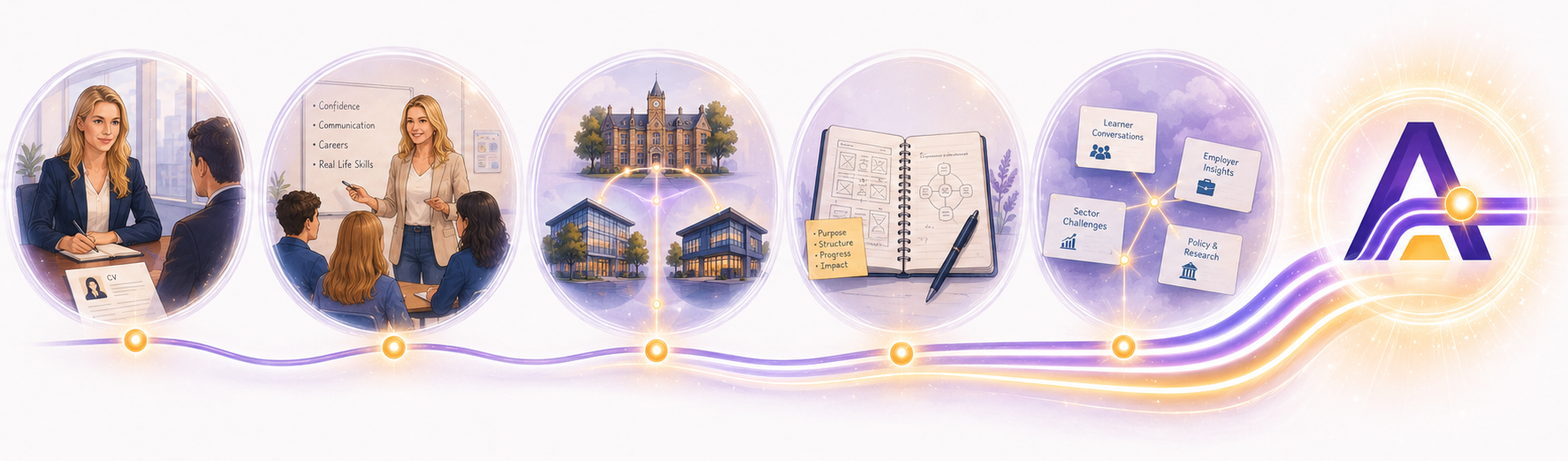
The platform isn't based on a single perspective or one person's experience. It brings together insights from education, commercial product development, learning design, recruitment, and extensive stakeholder research to create something that is both practical and evidence-led.
Every major design decision has been questioned, tested, and refined before becoming part of the platform.
Apparo comes from the Latin apparō - I prepare. I make ready.
It also shares its root with the English word apparatus: the complete set of tools, equipment, and support needed to accomplish something.
That felt like the right name.
Because Apparo is about giving young people the practical preparation, confidence, and tools they need before the moment matters, not simply about information.

The foundations behind Apparo
Qualified Teacher (QTS)
Professional Diploma in Digital Learning Design (Distinction)
Named Company Safeguarding Lead (current)
Commercial SaaS Product Leadership
GDPR implementation and digital product governance
Extensive primary research with learners, educators, employers, and recruiters
Education
Understanding the realities of education
Built by an experienced educator who understands the pressures schools, colleges and providers face, the realities of curriculum time, and the challenge of preparing young people for life beyond qualifications.
Apparo has been designed to strengthen existing provision - not compete with it.
Product
Digital products that change behaviour
Before entering education, Rebecca spent more than a decade designing and developing commercial digital products. That experience shaped one of Apparo's fundamental principles:
Good digital products don't simply deliver information. They help people do something differently.
Every Apparo learning experience has been built with that same philosophy.
Learning Design
Digital learning design to be remembered - and used.
Educational experience alone wasn't enough. Apparo's learning architecture is underpinned by formal instructional design, ensuring every module is designed around how people actually learn, practise, and apply new knowledge.
The goal isn't simply to complete learning. It's to use it confidently when the moment arrives.
Responsibility
Designed responsibly from the beginning.
Educational technology should be innovative, and it should also be responsible.
From the very beginning, Apparo has been developed with safeguarding, accessibility, instructional design, and data protection built into its foundations - not added later.
Because organisations shouldn't have to choose between innovation and confidence.
Research-led from the beginning
Every major design decision within Apparo can be traced back to one of these sources:
Real-world experience → Years spent recruiting, teaching, and designing digital products.
Primary research → Conversations with learners, educators, employers, and recruiters across multiple sectors.
Established evidence → Government policy, educational research, careers guidance, and workforce readiness literature.
Together, they form the foundation of every pathway, every module and every learning experience.
Interested in the research behind Apparo?
Explore the learner research, employer interviews, educator insights, and national evidence that shaped every major decision.